Turmeric Benefits: Why Is Turmeric So Important in Ayurveda?
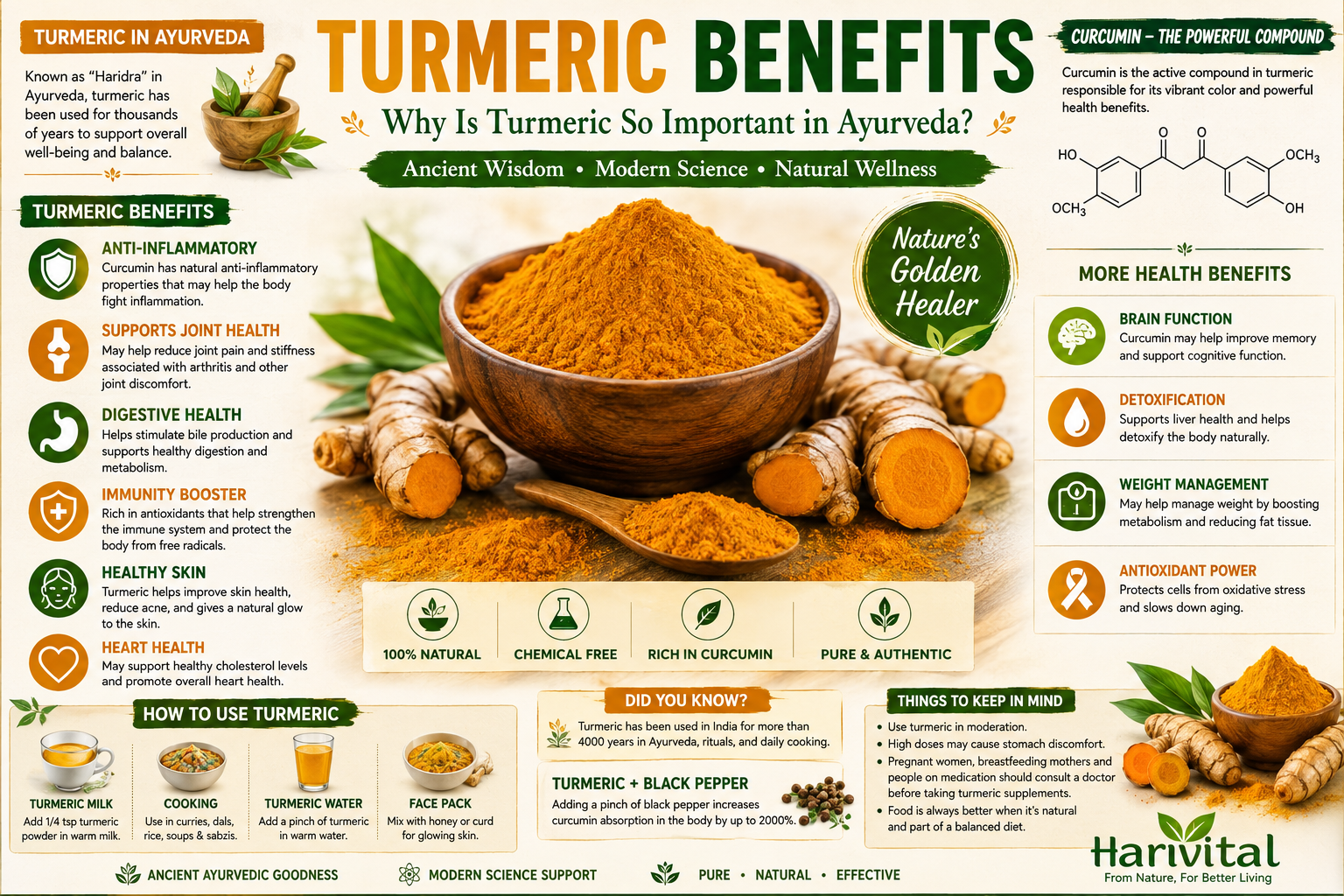
Turmeric has been part of Indian food, culture, and traditional wellness practices for centuries. Known as haldi in Hindi and commonly referred to as turmeric in English, this bright yellow spice is a familiar ingredient in kitchens across India.
But why has turmeric remained so important for so long?
The answer is not only its color and distinctive flavor. Turmeric contains naturally occurring compounds called curcuminoids, with curcumin being one of the best-known and most studied. Modern researchers have investigated curcumin for its antioxidant, inflammatory, metabolic, and other potential effects.
At the same time, traditional Ayurvedic use and modern scientific research are not exactly the same thing. Ayurveda has a long history of using turmeric in traditional preparations, while modern science evaluates specific compounds, doses, formulations, and health outcomes through laboratory studies and clinical trials.
So, what do the Turmeric Benefits actually mean?
Let us look at turmeric from both perspectives.
What Is Turmeric?
Turmeric comes from the underground rhizome of Curcuma longa, a plant belonging to the ginger family.
After harvesting, the rhizomes are generally cleaned, boiled or processed, dried, and ground into the familiar yellow turmeric powder used in Indian cooking.
India has a particularly strong connection with turmeric. It is widely used in everyday cooking and has also been associated with traditional ceremonies and Ayurvedic practices.
The bright yellow color comes largely from curcuminoids, especially curcumin.
Turmeric is therefore more than a kitchen spice. It represents an interesting meeting point between traditional Indian knowledge, food culture, and modern scientific research.
Why Is Turmeric Important in Ayurveda?
Turmeric has a long history of use in Indian traditional medicine.
Ayurveda is a traditional Indian system that takes a holistic approach to health, incorporating food, lifestyle, herbs, and other practices.
Turmeric has traditionally been used in Ayurvedic preparations for a variety of purposes. Modern sources also recognize its historical use in Indian traditional medicine for concerns such as indigestion, skin problems, and inflammatory conditions.
However, it is important to make a distinction.
A traditional use does not automatically prove that a product can prevent or cure a modern medical condition.
Traditional knowledge provides historical context, while clinical research helps determine whether a particular intervention is effective and safe for a specific health condition.
That distinction makes the discussion around Turmeric Benefits in Ayurveda much more useful and responsible.
What Makes Turmeric Special?
The most discussed component of turmeric is curcumin.
Curcumin belongs to a group of compounds called curcuminoids and is responsible for much of turmeric’s characteristic yellow color.
Researchers have studied curcumin because laboratory research suggests that it can influence pathways involved in inflammation and oxidative stress.
A large 2024 systematic review and meta-analysis examined 103 randomized controlled trials involving more than 7,000 participants and found statistically significant effects for some measured outcomes. However, the researchers also noted that evidence quality varied considerably across outcomes and that better long-term trials are still needed.
This is why it is better to say “curcumin is being studied for potential health benefits” rather than claiming that turmeric is a guaranteed treatment.
Turmeric Benefits and Antioxidant Activity
One reason turmeric receives so much scientific attention is its potential antioxidant activity.
Our bodies naturally produce molecules involved in oxidative processes. The body also has its own antioxidant defense systems.
Curcumin has demonstrated antioxidant activity in laboratory research, and human studies have investigated markers related to oxidative stress.
This sounds promising, but there is an important difference between laboratory findings and proven health outcomes in people.
A compound showing antioxidant activity in a laboratory does not automatically mean that eating turmeric will prevent a particular disease.
Therefore, turmeric should be viewed as one nutritious ingredient within a balanced diet—not as a replacement for vegetables, fruits, whole grains, exercise, medical care, or prescribed treatment.
Turmeric for Inflammation: What Does Research Say?
Turmeric for inflammation is one of the most popular health topics surrounding this spice.
Curcumin has demonstrated potential anti-inflammatory properties in laboratory research, and clinical studies have investigated its effects in several inflammatory and musculoskeletal conditions.
Some systematic reviews have reported promising results, particularly for measures related to osteoarthritis and certain types of pain. However, the evidence is not strong enough to say that turmeric supplements are a proven treatment for all inflammatory diseases.
This is an important point for readers.
Using turmeric in everyday food is very different from taking a concentrated curcumin supplement.
The amount of curcumin in ordinary turmeric powder can vary, and supplement formulations can differ substantially in concentration and absorption.
Turmeric Powder as an Everyday Food
For most people, the simplest way to enjoy turmeric is as part of food.
In Indian cooking, turmeric powder is commonly added to dal, vegetables, curries, soups, rice dishes, and many other recipes.
This makes turmeric easy to include in a normal eating pattern without turning it into a complicated wellness routine.
You can use a small amount of turmeric powder while cooking and combine it with a variety of other herbs, spices, vegetables, pulses, and whole foods.
The goal is not to consume huge quantities.
A healthy diet is built from many foods working together.
What About Turmeric and Black Pepper?
You may have heard that black pepper makes turmeric more effective.
This idea comes from research showing that piperine, a compound found in black pepper, can increase the bioavailability of curcumin.
Some commercial curcumin supplements deliberately combine curcumin with piperine or use other formulations designed to increase absorption.
However, higher absorption does not automatically mean greater health benefits.
More bioavailable formulations also deserve careful consideration because concentrated curcumin products are not the same as ordinary culinary turmeric.
For everyday cooking, turmeric and black pepper can simply be used together for flavor.
There is no need to turn a traditional food combination into a guaranteed medical remedy.
Turmeric Health Benefits: What Can We Actually Say?
Current research has investigated Turmeric Health Benefits across several areas, including joint health, metabolic markers, liver-related outcomes, and inflammatory processes.
Some studies are encouraging.
For example, research on osteoarthritis has reported preliminary positive findings for knee pain and stiffness, although higher-quality evidence is still needed.
Research has also explored turmeric and curcumin in people with metabolic fatty liver disease, with some studies reporting improvements in certain liver enzymes. However, researchers continue to call for stronger clinical evidence before firm conclusions can be made.
So the most accurate conclusion is simple:
Turmeric is promising, but promising is not the same as proven.
Turmeric Is Food First, Not a Miracle Cure
One of the biggest mistakes in online health content is turning a traditional ingredient into a miracle cure.
Turmeric deserves appreciation for its culinary value, cultural importance, and interesting scientific potential.
But no single spice can replace a balanced diet and healthy lifestyle.
Use turmeric to add flavor and color to nutritious meals.
Eat a variety of vegetables and fruits.
Include pulses, whole grains, nuts, seeds, and suitable protein sources.
Stay physically active.
Sleep well.
And seek professional medical advice when you have a health condition.
That is a much more realistic way to understand the true Turmeric Benefits.
Turmeric Health Benefits: What Does Modern Research Say?
The traditional importance of turmeric is clear, but modern readers also want to know what science says.
Research on turmeric and curcumin is growing rapidly. Scientists have investigated their potential effects on inflammation, joint discomfort, digestive health, metabolic health, and several other areas.
However, research results are not the same as medical proof.
Some studies are promising, while others are small, short-term, or use concentrated curcumin formulations that may behave differently from ordinary turmeric powder.
That is why it is better to think of turmeric as a nutritious and traditional spice with interesting research behind it—not as a universal medicine.
Turmeric for Inflammation
Turmeric for inflammation is one of the most popular topics in natural health.
Curcumin has been studied because laboratory research suggests that it can influence several biological pathways associated with inflammation. This is one reason researchers continue to investigate its potential health effects.
But there is an important distinction.
Laboratory findings do not automatically mean that eating turmeric will treat an inflammatory disease.
According to the National Center for Complementary and Integrative Health, preliminary findings suggest anti-inflammatory properties, but there is still insufficient evidence to support turmeric supplementation as an established treatment for inflammatory disorders.
So, when discussing Turmeric Health Benefits, responsible wording matters.
Turmeric may have anti-inflammatory potential, but it should not replace prescribed treatment.
Turmeric and Joint Health
Joint health is another area where Curcumin Benefits have attracted significant scientific interest.
Researchers have studied turmeric and curcumin preparations in people with knee osteoarthritis and other forms of musculoskeletal discomfort.
Some systematic reviews have reported improvements in pain or physical function compared with placebo. At the same time, researchers have noted uncertainty around the ideal dose, frequency, and formulation.
This is important because curcumin supplements can vary considerably.
A concentrated supplement is not the same thing as adding a small amount of turmeric powder to dal or vegetables.
Therefore, it would be inaccurate to promise that ordinary kitchen turmeric will produce the same results seen in a clinical study using a standardized extract.
Turmeric and Digestive Health
Turmeric has also been traditionally associated with digestive health.
In India, haldi has long been used as part of food and traditional preparations.
Modern research has explored curcumin in several digestive conditions, but evidence differs from one condition to another.
For example, some preliminary research has investigated curcumin for symptoms associated with irritable bowel syndrome, but the evidence has been considered very limited.
This means turmeric can certainly be part of a balanced diet, but it should not be presented as a proven treatment for digestive disorders.
If you have persistent abdominal pain, unexplained weight loss, blood in the stool, severe acidity, or ongoing digestive symptoms, consult a healthcare professional rather than relying on turmeric alone.
Turmeric and Antioxidant Activity
Curcumin has also attracted interest because of its antioxidant activity.
Antioxidants are compounds that can interact with free radicals and oxidative processes in the body.
Laboratory research has shown interesting effects of curcumin in antioxidant-related pathways. However, the human health significance of these effects depends on factors such as dose, absorption, metabolism, and the specific health condition being studied.
This is another reason not to turn a laboratory finding into an exaggerated health claim.
A balanced diet already provides many antioxidant compounds through fruits, vegetables, legumes, nuts, seeds, herbs, and spices.
Turmeric can be one part of that broader dietary pattern.
How to Use Turmeric Powder in Indian Cooking
One of the biggest advantages of turmeric is how easily it fits into everyday Indian food.
You do not need a complicated recipe.
A small amount of turmeric powder can be added to:
- Dal
- Sabzi
- Khichdi
- Vegetable soups
- Curries
- Rice dishes
- Lentil preparations
- Homemade masalas
- Pickles
- Traditional drinks
This makes turmeric different from many trendy health ingredients.
It is already part of Indian cooking.
For many people, using turmeric as a spice is a simple way to enjoy its flavor, color, and traditional value without treating food as medicine.
Turmeric with Black Pepper
You may have heard that black pepper makes turmeric more effective.
There is a scientific reason behind this discussion.
Piperine, a compound found in black pepper, has been studied for its ability to increase the bioavailability of curcumin.
This is one reason some curcumin supplements combine curcumin with piperine or use other formulations designed to improve absorption.
However, supplement formulations and kitchen cooking are not identical.
You should not assume that adding a large amount of black pepper will turn turmeric into a powerful medicine.
For normal cooking, black pepper and turmeric can simply be used together because they work well as spices.
Turmeric Milk: A Traditional Indian Preparation
Haldi doodh, or turmeric milk, is one of India’s best-known traditional turmeric preparations.
A small amount of turmeric powder is mixed with warm milk or another suitable beverage.
The combination is now also known internationally as “golden milk.”
The Ministry of Ayush has included a turmeric-based golden milk preparation in certain public health guidance documents, reflecting the continuing place of haldi in Indian traditional practices.
However, traditional use should not be confused with proof that turmeric milk can cure a disease.
You can enjoy it as a traditional beverage, but it should not replace medical care.
How Much Turmeric Should You Use?
There is no single universally established daily dose of turmeric powder that applies to everyone.
The amount used in food is generally much smaller than the doses found in concentrated supplements.
This distinction is important.
Research studies may use specific curcumin extracts, formulations, and doses that cannot simply be converted into teaspoons of household turmeric powder.
If you are considering a concentrated curcumin supplement, follow the product instructions and discuss it with a healthcare professional if you have a medical condition or take medicines.
More is not automatically better.
Turmeric Powder vs Curcumin Supplement
This is one of the most important differences to understand.
Turmeric Powder
Turmeric powder is the ground spice made from Curcuma longa.
It contains curcuminoids along with other naturally occurring compounds.
It is primarily used as a food ingredient.
Curcumin Supplement
A curcumin supplement usually contains a concentrated or standardized preparation.
Some formulations are designed to improve absorption.
Because the composition and dose can be very different, research involving a curcumin supplement should not automatically be interpreted as evidence that ordinary turmeric powder has the same effect.
For everyday use, turmeric powder can simply be treated as a traditional culinary spice.
Supplements are a different category and deserve more careful consideration.
Is Turmeric Safe?
For most adults, turmeric used as a food ingredient is generally considered safe.
However, higher doses or long-term use can cause digestive side effects such as indigestion, nausea, or diarrhea.
Concentrated turmeric and curcumin products also deserve more caution.
Recent research has raised concerns about possible liver injury associated with some turmeric or curcumin products in susceptible people.
This does not mean that ordinary culinary turmeric is dangerous.
It means that concentrated supplements should not automatically be treated as harmless simply because they are marketed as natural.
Who Should Be Careful With Turmeric Supplements?
If you are considering a concentrated turmeric or curcumin supplement, speak with a healthcare professional first if you:
- Take prescription medicines
- Have liver or gallbladder problems
- Have a bleeding disorder
- Are pregnant or breastfeeding
- Have an upcoming surgery
- Have a chronic medical condition
- Take several supplements at the same time
The safety of herbal products can depend on the person, the product, the dose, and possible interactions with medicines.
Food and supplements should not automatically be treated as the same thing.
Turmeric and Ayurveda: Tradition Meets Modern Research
One reason turmeric remains so fascinating is the connection between ancient knowledge and modern science.
Ayurveda has used turmeric for generations, while researchers today are studying individual compounds such as curcumin.
These are two different ways of looking at the same plant.
Traditional Ayurveda considers the herb within a broader system of diet, lifestyle, and health.
Modern research isolates particular compounds and investigates specific biological effects through laboratory studies, clinical trials, and systematic reviews.
Neither approach should be exaggerated.
Traditional use does not automatically prove a modern medical claim.
Likewise, an interesting laboratory result does not automatically mean that a food ingredient can treat a disease in humans.
The most useful approach is to respect traditional knowledge while also looking carefully at modern evidence.
How Harivital Can Fit Into This Tradition
For an Indian natural-food brand such as Harivital, turmeric is a particularly relevant ingredient because it connects everyday Indian cooking with India’s long-standing relationship with traditional herbs and spices.
The best way to communicate turmeric is honestly.
Talk about its traditional importance.
Explain what turmeric powder is.
Discuss Turmeric Benefits in Ayurveda.
Explain the difference between turmeric and curcumin.
Share what current research suggests about Curcumin Benefits.
And clearly explain where scientific evidence is still developing.
This creates useful content for readers without making exaggerated health promises.
Final Takeaway
Turmeric has earned its place in Indian kitchens for good reason.
It provides color, flavor, cultural value, and a long history of traditional use.
Modern science has also made turmeric and curcumin important subjects of research, particularly around inflammation and joint health. Some findings are encouraging, but many questions about dosage, formulation, absorption, and long-term effects remain.
The simplest approach is often the most practical:
Use turmeric as part of a varied, balanced diet.
Add turmeric powder to dal, vegetables, curries, rice dishes, or other foods you already enjoy.
If you are considering concentrated curcumin supplements, understand that they are different from ordinary culinary turmeric and speak with a healthcare professional when appropriate.
Ultimately, the story of turmeric is not about one magical ingredient.
It is about a traditional Indian spice that has travelled from kitchens and Ayurvedic traditions into modern scientific research.
And that combination of tradition, food, and research is what makes turmeric such an interesting part of India’s natural wellness heritage.