
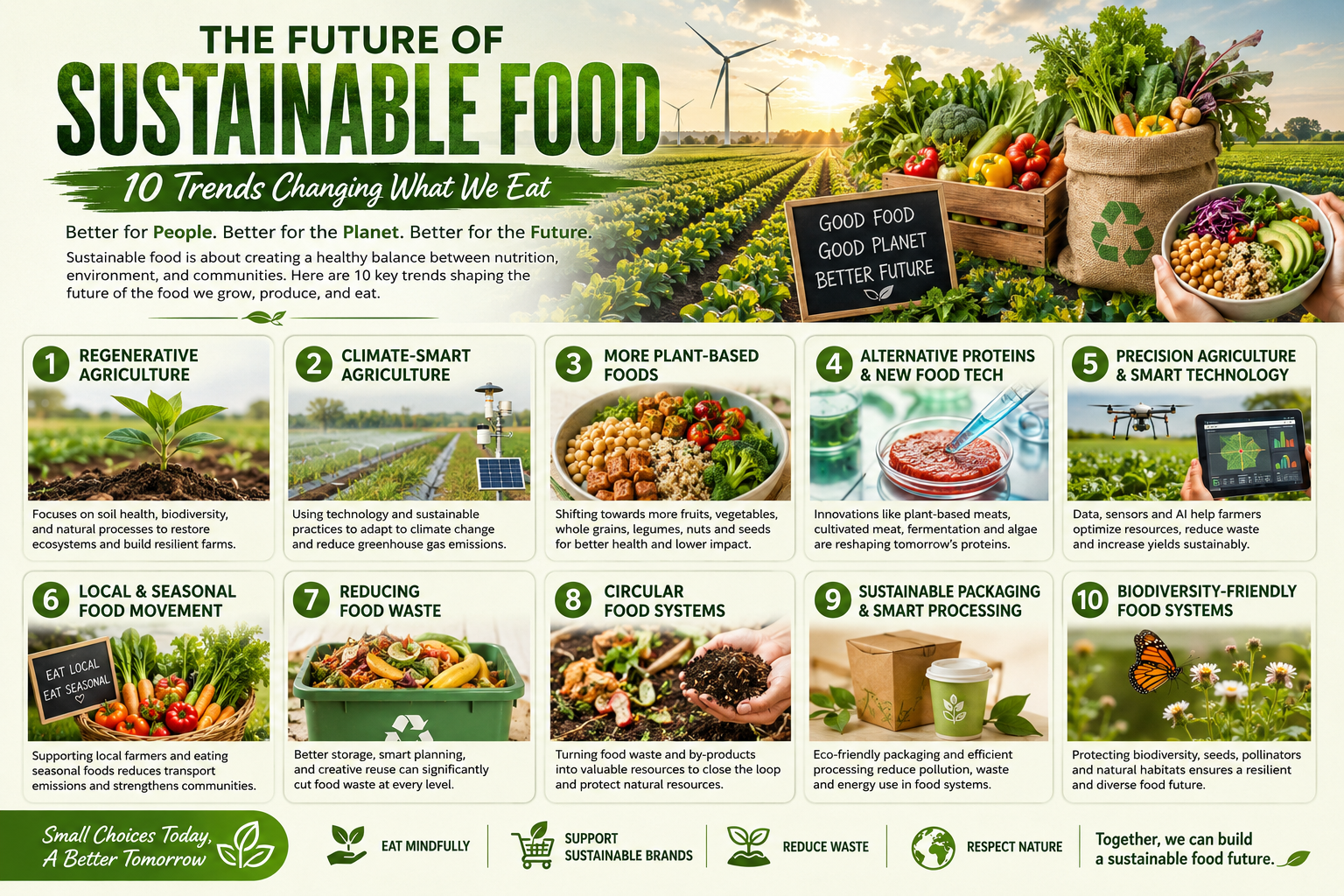
Sustainable Food: 10 Trends Shaping the Future of Food
Sustainable Food,Food is something we experience every day, but the way it reaches our plates is changing rapidly. Farmers, food producers, researchers, businesses, governments, and consumers are all looking for ways to produce nutritious food while using natural resources more responsibly.
This is where Sustainable Food becomes important.
Sustainable food is not simply about choosing organic products or avoiding plastic packaging. It is a much broader idea that considers how food is grown, processed, transported, sold, consumed, and eventually discarded. A truly sustainable food system needs to support food security and nutrition while also protecting environmental resources and supporting people and livelihoods. The Food and Agriculture Organization of the United Nations describes sustainable agrifood systems through economic, social, and environmental dimensions.
The need for change is significant. Food systems have a major environmental footprint. Agriculture uses around half of the world’s habitable land, while food systems account for roughly one-quarter of global greenhouse gas emissions in widely cited estimates.
At the same time, millions of people still struggle to access enough nutritious food.
So, what could the Future of Food look like?
Here are 10 important trends that are already influencing the food system and could become even more important in the years ahead.
1. Regenerative Agriculture
One of the most discussed Sustainable Food Trends is regenerative agriculture.
Regenerative agriculture focuses on improving the health and resilience of agricultural ecosystems. Depending on the farm and region, practices may include keeping soil covered, reducing unnecessary soil disturbance, using crop rotations, integrating livestock where appropriate, planting cover crops, and increasing plant diversity.
The basic idea is simple: instead of treating soil as an unlimited production surface, farmers can manage it as a living ecosystem.
Healthy soil can support water retention, nutrient cycling, plant growth, and biodiversity. Better soil management can also help farms become more resilient to certain environmental stresses.
However, regenerative agriculture does not have one universal rulebook. A practice that works well in one climate or farming system may not be suitable everywhere. Local soil, rainfall, crops, livestock, infrastructure, and farmer knowledge all matter.
That is why the future of sustainable farming will likely depend on practical, region-specific approaches rather than one single farming method.
2. Climate-Smart Agriculture
Climate change is making farming more challenging in many parts of the world.
Farmers can face changing rainfall patterns, heat, drought, floods, soil degradation, pests, and other pressures. At the same time, agriculture itself contributes to greenhouse gas emissions.
Climate-smart agriculture attempts to address both sides of this challenge.
The approach generally focuses on increasing agricultural productivity and resilience while looking for opportunities to reduce greenhouse gas emissions where possible.
Examples can include improved water management, better soil practices, drought-tolerant crop varieties, precision agriculture, improved livestock management, agroforestry, and better use of weather and climate information.
This does not mean every farm needs expensive technology.
Sometimes a sustainable solution can be remarkably simple. Better irrigation scheduling, choosing an appropriate crop for local conditions, protecting soil from erosion, or improving organic matter can make a meaningful difference.
The important shift is toward farming systems that are prepared for future conditions rather than relying entirely on yesterday’s climate.
3. More Plant-Based Foods
Another major development in the Future of Food is the growing interest in plant-based eating.
This does not necessarily mean that everyone will become vegetarian or vegan. Instead, many people are simply adding more plant foods to their existing diets.
Beans, lentils, chickpeas, peas, vegetables, fruits, whole grains, nuts, and seeds can all contribute to a diverse diet.
From an environmental perspective, food choices can have very different footprints. Research compiled by Our World in Data shows substantial differences in land requirements and greenhouse gas emissions between different food products. In particular, beef and lamb generally have much higher land footprints than many plant-based protein sources.
This does not mean that one food is automatically “good” or “bad.” Nutrition, culture, affordability, availability, farming methods, and individual dietary requirements all matter.
The broader trend is about expanding the role of plant-based foods.
A meal built around lentils, vegetables, whole grains, beans, or other plant foods can be nutritious while also reducing dependence on resource-intensive food production.
As consumers become more interested in environmental impacts, food companies are also experimenting with new plant-based products, alternative proteins, and improved formulations.
4. Alternative Proteins and New Food Technologies
The food industry is also exploring new ways to provide protein.
Traditional plant proteins such as soy, peas, beans, lentils, and chickpeas are already widely available. However, researchers and food companies are developing additional options, including fermentation-derived proteins, cultivated meat, algae-based ingredients, and other emerging technologies.
These technologies are part of a larger conversation about how the world can meet future nutritional needs while managing environmental pressures.
Some technologies are already commercially available in certain markets, while others remain at an earlier research or regulatory stage.
It is important not to assume that every new food technology is automatically sustainable. The environmental impact depends on energy use, ingredients, production methods, processing, transportation, scale, and waste.
For example, a highly processed product may have a different environmental footprint from a simple food such as beans or lentils.
Therefore, the future is unlikely to be about replacing every traditional food with a high-tech alternative.
Instead, the more realistic picture may be a diverse food system in which traditional crops, improved farming techniques, plant-based proteins, fermentation, and carefully developed new technologies all have a role.
5. Precision Agriculture and Smarter Use of Resources
Modern technology is giving farmers new ways to understand what is happening in their fields.
Precision agriculture uses tools such as satellite imagery, sensors, GPS systems, drones, weather data, soil monitoring, and farm-management software to make more targeted decisions.
Instead of treating an entire field exactly the same, farmers can identify areas that need more water, nutrients, or attention.
This can potentially improve resource efficiency.
For example, better information may help a farmer identify where irrigation is needed instead of watering every part of a field equally. Similarly, soil testing and crop monitoring can help farmers make more informed decisions about nutrient applications.
Technology can also help farmers monitor crop health, identify problems earlier, and plan harvesting.
However, access remains an important issue.
Large farms may have more money to invest in advanced technology, while smallholder farmers may face financial, technical, or connectivity barriers.
For precision agriculture to become a meaningful part of Sustainable Food systems worldwide, technology needs to become more affordable, practical, and accessible.
Digital tools should support farmers rather than simply add another layer of complexity.
Why These Trends Matter
These five trends show that sustainability is not one single idea.
It involves soil.
It involves water.
It involves climate.
It involves biodiversity.
It involves farming technology.
It involves nutrition.
And it also involves the people who produce and consume food.
Agriculture already occupies a huge share of the world’s habitable land, so producing more food cannot simply mean continuously expanding farmland. Our World in Data notes that agricultural land use has major consequences for biodiversity and natural habitats.
At the same time, food production needs to remain productive enough to feed a growing and increasingly urbanized global population.
That creates a difficult balance.
The goal is not simply to produce the maximum amount of food at any environmental cost. Nor is sustainability achieved by ignoring affordability, nutrition, farmer livelihoods, or food security.
A genuinely sustainable food system has to consider all of these factors together.
Sustainability Is Also About What Happens After Harvest
The food journey does not end when crops leave the farm.
Food is transported, stored, processed, packaged, sold, cooked, eaten, and sometimes thrown away.
Every stage can influence the overall environmental footprint.
This is particularly important because a significant amount of food never gets eaten.
According to the UNEP Food Waste Index 2024, approximately 1.05 billion tonnes of food waste were generated in 2022 at the household, food-service, and retail levels. That represented almost one-fifth of the food available to consumers. Households accounted for around 60% of this waste.
This means that producing food more sustainably is only part of the solution.
If perfectly edible food is produced using land, water, energy, labor, and other resources and then discarded, those resources have been used without delivering the intended nutritional benefit.
That is why reducing food waste is becoming one of the most important Sustainable Food Trends.
The Role of Consumers
Consumers also influence the food system through everyday decisions.
Buying seasonal foods, reducing unnecessary food waste, choosing more plant-based meals, storing food properly, supporting responsible producers, and learning how food is produced can all contribute to a more thoughtful food culture.
However, responsibility should not fall entirely on individuals.
Food systems are complex. Farmers, food companies, retailers, governments, restaurants, logistics providers, and consumers all influence what happens.
For example, consumers cannot solve inefficient cold-storage infrastructure on their own. Farmers cannot redesign national food policy alone. Retailers cannot solve every household food-waste problem.
Real progress requires cooperation across the entire food chain.
What the Future May Look Like
The future of sustainable food will probably not be defined by one revolutionary invention.
Instead, it may be shaped by thousands of smaller improvements happening simultaneously.
Farmers may use better soil-management practices.
Technology may help reduce unnecessary water and fertilizer use.
More consumers may include legumes, whole grains, vegetables, fruits, nuts, and seeds in their meals.
Food producers may develop more efficient processing systems.
Retailers may improve storage and inventory management.
Households may become better at planning meals and using leftovers.
Cities may invest in composting and circular food systems.
And researchers may continue developing new approaches to food production.
Together, these changes can reshape how food moves from farm to fork.
What Comes Next?
The first five trends show how agriculture, technology, and changing food choices are beginning to influence the global food system.
But there is another major part of the story.
The Future of Food will also depend on regenerative and circular food systems, local and seasonal food, sustainable packaging, food-waste reduction, biodiversity, and better use of food by-products
6. Local and Seasonal Food
One of the most practical Sustainable Food Trends is the growing interest in local and seasonal food.
Buying food produced closer to where it is consumed can strengthen local agricultural economies and shorten some supply chains. More importantly, seasonal food encourages people to understand what grows naturally in their region and at what time of year.
However, “local” does not automatically mean that a food has the lowest environmental impact.
The environmental footprint of food depends on many factors, including how it was produced, how much land and water were required, how it was stored, how it was transported, and how it was prepared.
For example, a food that travels a longer distance by efficient transport can sometimes have a lower footprint than a locally produced food grown in a highly energy-intensive system.
This is why the Future of Food is unlikely to be based on a simple rule such as “everything must be local.”
Instead, consumers and food businesses will increasingly need to look at the entire food system.
Local food can still offer important benefits beyond transportation. It can create stronger relationships between farmers and consumers, support regional economies, preserve traditional crops, and make food systems more connected to local communities.
Farmers’ markets, community-supported agriculture, farm shops, local food cooperatives, and direct-to-consumer models are examples of ways this connection can grow.
7. Reducing Food Waste
Food waste is one of the clearest areas where the food system can improve.
Imagine the resources that go into growing a crop: land, water, seeds, fertilizer, labor, machinery, energy, transportation, storage, and processing.
If that food is never eaten, much of that investment has produced no nutritional benefit.
UNEP’s Food Waste Index 2024 estimated that about 1.05 billion tonnes of food waste were generated in 2022 across households, food service, and retail. Households represented the largest share of this waste.
Reducing waste therefore has an important place in Sustainable Food systems.
The solutions can begin at home.
People can plan meals before shopping, store food correctly, understand date labels, freeze foods that may not be eaten soon, use leftovers creatively, and avoid buying more food than they can reasonably consume.
Restaurants and food businesses can also improve inventory management, portion planning, storage systems, donation programs, and food redistribution.
At the farming and supply-chain level, better harvesting, storage, cooling, transportation, and processing can help reduce food losses before products even reach consumers.
The future may also bring better technologies for monitoring freshness and managing food inventories.
The goal is not simply to produce more food.
It is to make sure that more of the food already produced actually reaches people.
8. Circular Food Systems
Traditional economic systems often follow a linear pattern:
Take → Make → Use → Dispose
A circular food system tries to move toward something different:
Produce → Use → Recover → Reuse
This can involve turning food by-products into useful ingredients, returning suitable organic materials to soils, recovering nutrients, using agricultural residues, and finding safe new uses for materials that would otherwise become waste.
FAO identifies circular approaches as an important part of agrifood transformation, while also emphasizing that food safety must remain a priority when materials are reused.
For example, some agricultural by-products can become animal feed, compost, bio-based materials, or ingredients for other products when appropriate and safe.
Fruit and vegetable processing can generate peels, seeds, pulp, and other materials. Grain processing can create different by-products. Agricultural residues can sometimes be returned to soil or used in other productive ways.
But circularity does not mean that every waste material should automatically be reused.
Safety matters.
Potential biological, chemical, or physical contaminants must be considered before food waste, water, packaging, or agricultural by-products are reused.
The most successful circular food systems will therefore combine sustainability with strong food-safety standards.
9. Sustainable Packaging and Smarter Food Processing
Packaging has an important role in modern food systems.
It can protect food from contamination, extend shelf life, reduce damage during transportation, and make distribution easier.
At the same time, packaging can create waste and require energy and raw materials.
This creates a difficult balance.
Removing packaging is not always the most sustainable solution because food spoilage can sometimes create a larger environmental cost than the packaging itself.
The better question is:
What type and amount of packaging protects the food while minimizing unnecessary environmental impact?
This is where future innovation can become important.
Food companies are exploring recyclable materials, reusable packaging systems, lighter packaging, improved barrier materials, concentrated products, and alternative packaging designs.
However, consumers should be careful with simple environmental claims.
A package described as “eco-friendly” does not automatically mean it is the best choice in every situation.
The complete life cycle matters, including raw materials, manufacturing, transportation, use, recycling or reuse, and final disposal.
Food processing itself is also changing.
More efficient equipment, renewable energy, better cold-chain systems, improved water management, and reduced processing waste can help food businesses become more resource-efficient.
As technology improves, the Future of Food may involve both smarter packaging and smarter processing rather than simply using less packaging everywhere.
10. Biodiversity-Friendly Food Systems
The tenth major trend is perhaps one of the most important: protecting biodiversity.
Biodiversity includes the enormous variety of plants, animals, microorganisms, genes, and ecosystems that support life.
Agriculture depends on biodiversity, but agriculture can also influence it.
Pollinators help many crops reproduce. Soil organisms contribute to nutrient cycling. Diverse plant systems can support ecosystem functions. Genetic diversity in crops and livestock can help agriculture maintain resilience.
FAO describes biodiversity as a foundation of sustainable agricultural production and food security. It also notes that agrifood systems both depend on biodiversity and affect it.
This makes biodiversity an important part of Sustainable Food.
A food system that depends heavily on a narrow range of crops can become vulnerable to pests, diseases, climate stresses, and other disruptions.
Maintaining crop diversity can provide farmers with more options.
Traditional and locally adapted varieties may also have cultural and agricultural value.
Biodiversity-friendly farming can include practices such as crop diversification, agroforestry, maintaining habitats for beneficial insects, protecting natural areas around farms, and reducing unnecessary pressure on ecosystems.
There is no single biodiversity strategy that works everywhere.
A rice-growing region, a dryland farming area, a tropical plantation, and a mixed livestock farm will have very different ecological conditions.
The future will therefore require solutions adapted to local landscapes.
What Will Consumers Eat in the Future?
The Future of Food will not be determined only by scientists and food companies.
Consumers will have a major influence.
Food choices create demand. When millions of people consistently buy certain foods, businesses have an incentive to produce, distribute, and develop more of those products.
This does not mean consumers need to completely change their diets.
Small, realistic changes can matter.
People can eat a wider variety of plant foods, reduce unnecessary food waste, choose seasonal produce when practical, learn where their food comes from, and support food producers who use responsible practices.
A balanced approach is more realistic than extreme rules.
For example, someone does not have to eliminate every animal-based food to eat more sustainably. Adding more legumes, vegetables, whole grains, fruits, nuts, and seeds can be one practical step.
Similarly, someone does not need to buy every product labeled “sustainable.”
Understanding how food is produced is more useful than relying only on marketing claims.
Will Sustainable Food Be More Expensive?
Cost is one of the biggest questions surrounding sustainable food.
Some sustainable products can cost more because they may involve more labor, certification, specialized production methods, smaller production volumes, or more expensive supply chains.
But sustainability cannot work if nutritious food becomes inaccessible to large sections of society.
FAO emphasizes that sustainable agrifood systems have economic and social dimensions alongside environmental sustainability. They need to support livelihoods, nutrition, equity, and food security as well as natural resources.
This means the future challenge is not simply:
How do we make food greener?
It is:
How do we make food sustainable, nutritious, affordable, resilient, and accessible at the same time?
That is a much harder question.
It requires investment in farmers, infrastructure, research, technology, education, markets, and public policy.
The Role of Farmers
Farmers are at the center of the food system.
They make decisions about crops, livestock, soil, water, inputs, machinery, harvesting, and land management.
However, farmers cannot transform the food system alone.
A farmer may want to adopt a more sustainable practice but lack access to affordable credit, technology, irrigation, storage, markets, or reliable information.
This is why successful Sustainable Food Trends need to consider farmer livelihoods.
A practice that looks environmentally attractive but makes farming financially impossible is unlikely to succeed at scale.
FAO’s recent work on climate-resilient agrifood systems highlights the importance of investment, policy, planning, and implementation alongside technical solutions.
The future should therefore give farmers practical choices rather than simply placing more responsibilities on them.
The Importance of Soil
One resource deserves special attention: soil.
Healthy soil supports plant growth, stores and cycles nutrients, holds water, and contains an enormous community of microorganisms.
FAO identifies sustainable soil management as one pathway for making agrifood systems more resilient. Practices such as cover crops, mulching, crop-residue management, and appropriate soil amendments can help improve soil functions and reduce erosion.
This matters because soil is not an unlimited resource.
If soil becomes degraded, farmers may need more inputs to maintain productivity, while the land can become more vulnerable to drought and erosion.
Protecting soil today is therefore an investment in future food production.
Water Will Shape the Future of Food
Food production also depends heavily on water.
Crops need water to grow, livestock require water, and food processing uses water at multiple stages.
In water-stressed regions, improving water efficiency can become increasingly important.
Farmers can use approaches such as improved irrigation scheduling, efficient irrigation systems, soil moisture monitoring, rainwater management, drought-tolerant crops, and better soil practices where appropriate.
Again, there is no universal solution.
A strategy suitable for a water-rich region may not be appropriate for an arid agricultural area.
The most effective solutions will be adapted to local climate, crops, soils, infrastructure, and farmer needs.
Can Sustainable Food Feed the World?
This is one of the biggest questions.
The world needs food that is nutritious, affordable, safe, and available to people in different regions.
At the same time, food production places pressure on land, water, climate, and biodiversity.
Our World in Data reports that agriculture uses about half of the world’s habitable land and that food systems account for roughly one-quarter of global greenhouse gas emissions in widely cited estimates.
These numbers explain why food-system transformation matters.
But sustainability should not be interpreted as simply producing less food.
The objective is to produce nutritious food more efficiently while reducing unnecessary environmental damage and protecting the resources needed for future production.
This may involve a combination of:
- Better soil management
- More efficient water use
- Reduced food waste
- Improved crop diversity
- More efficient supply chains
- Greater use of plant-based foods
- Better farming technology
- Biodiversity protection
- Responsible packaging
- Circular use of resources
No single solution will be enough.
The Future Will Be a Combination of Old and New
One common mistake is to imagine that the future of food will be completely futuristic.
In reality, some of the most useful solutions may be very old.
Crop rotation is not new.
Composting is not new.
Fermentation is not new.
Traditional grains and legumes are not new.
Saving seeds and protecting agricultural biodiversity are not new.
What is changing is the ability to combine traditional knowledge with modern science, data, technology, and better infrastructure.
For example, farmers can combine traditional crop knowledge with satellite monitoring.
A traditional food can be processed using more efficient equipment.
Organic residues can be managed using modern composting systems.
Ancient grains can enter modern food markets.
The future does not necessarily mean replacing traditional agriculture.
It can mean improving it.
What Businesses Can Do
Food businesses also have an important role in building more sustainable systems.
They can begin by understanding their supply chains.
Where do raw materials come from?
How are they produced?
How much water and energy are used?
How much food is lost?
What happens to by-products?
How long does the product remain fresh?
What happens to the packaging after use?
These questions can reveal opportunities for improvement.
Businesses can also work more closely with farmers and suppliers instead of treating sustainability as a marketing slogan.
Transparent sourcing, responsible procurement, waste reduction, efficient processing, and honest environmental communication can help build stronger food systems.
What Individuals Can Do
Sustainable eating does not have to be complicated.
A person can start with a few simple habits:
- Eat more whole plant foods.
Add vegetables, fruits, legumes, whole grains, nuts, and seeds regularly. - Reduce avoidable food waste.
Plan meals, store food properly, and use leftovers. - Choose seasonal foods when practical.
Seasonal eating can connect consumers more closely with local agriculture. - Diversify your diet.
Eating a wider range of crops can support dietary variety and agricultural diversity. - Learn about food production.
Understanding where food comes from makes it easier to make informed choices. - Avoid unnecessary consumption.
Buying only what you can use is one of the simplest sustainability habits.
These actions are not about perfection.
They are about creating better habits over time.
The Biggest Challenge: Making Sustainability Work at Scale
There is a huge difference between a successful sustainable farm, restaurant, food company, or community project and transforming a global food system.
Scaling solutions requires money, infrastructure, research, policies, farmer participation, consumer acceptance, and reliable markets.
FAO’s work on the future of food emphasizes that transformation is possible, but it requires coordinated action and policy choices that support long-term sustainability and resilience.
This is why the next decade will be important.
The world already has many of the technologies and farming practices needed to make progress.
The challenge is implementing them in ways that are affordable, practical, safe, and suitable for different regions.
Final Thoughts
The future of food will not be shaped by one trend.
It will be shaped by many changes happening together.
Regenerative agriculture can improve soil management.
Climate-smart practices can help farms prepare for changing conditions.
Plant-based foods can provide additional dietary options.
Precision agriculture can help farmers make more informed decisions.
Local and seasonal food can strengthen connections between consumers and producers.
Food-waste reduction can prevent valuable resources from being wasted.
Circular systems can find productive uses for materials that would otherwise be discarded.
Better packaging and processing can reduce unnecessary resource use.
And biodiversity-friendly farming can help protect the ecological foundation on which agriculture depends.
Together, these developments represent some of the most important Sustainable Food Trends shaping the modern food system.
The idea of Sustainable Food is ultimately bigger than choosing one product over another.
It is about asking a broader question:
Can we produce and enjoy nutritious food today without making it harder for future generations to produce food tomorrow?
That question will continue to influence farmers, researchers, governments, food companies, and consumers around the world.
The Future of Food is still being written.
And it will probably be a combination of better science, smarter technology, traditional agricultural knowledge, responsible consumption, stronger food systems, and greater respect for the natural resources that make food possible in the first place.
Sources for Further Reading
For readers who want to explore the subject further, the following organizations provide useful research and educational resources:
- FAO — Sustainable Food and Agriculture: Information on sustainable agriculture, food security, natural resources, and the economic and social dimensions of sustainability.
- FAO — Agrifood Systems Transformation: Detailed information about how food systems can become more sustainable, resilient, inclusive, and efficient.
- UNEP — Food Waste: Global information about food waste and opportunities to reduce it.
- Our World in Data — Environmental Impacts of Food: Data and research on food emissions, land use, biodiversity, water, and different food products.
A Note on Sustainability
There is no universally perfect food or farming system.
Environmental impacts vary by location, production method, climate, technology, transport, storage, processing, and consumption patterns.
Therefore, sustainable food choices should be based on evidence and context rather than simple labels or absolute claims.
The goal is continuous improvement: producing nutritious food, protecting natural resources, supporting farmers and workers, reducing waste, and building food systems that remain resilient for generations to come.